
Psychiatry is entering a period of meaningful change. New mechanisms are advancing, established treatment approaches are being reconsidered, and clinicians are weighing innovation against the practical realities of treating patients whose symptoms often remain incompletely controlled.
By Sarah Soucy, Franchise Head, Neuroscience and Ophthalmology
Those tensions were evident throughout Psych Congress 2026 in New Orleans, where the Spherix Global Insights team joined clinicians, researchers, and other members of the psychiatric community to hear the conversations shaping care today and consider where treatment may be headed next.
Sessions addressing incomplete response, treatment sequencing, atypical antipsychotics, psychedelic therapies, and other emerging approaches reflected many of the same questions we have been examining in our ongoing research across depressive mood disorders, schizophrenia, and behavioral and psychiatric symptoms in Alzheimer’s disease.
The value of being part of these conversations extends beyond following what is new. It provides an opportunity to place emerging clinical evidence alongside what psychiatrists are reporting from everyday practice and to better understand where new approaches may meaningfully address persistent treatment gaps.
Incomplete Response Remains Central to the Conversation
At Psych Congress, discussions around treatment sequencing and augmentation repeatedly returned to a familiar challenge. For many patients, available therapies help, but do not necessarily produce the degree of response clinicians and patients are seeking.
Spherix examined this issue directly in research presented at the meeting in the poster Psychiatrist Perspectives on Unmet Need, Treatment Outcomes, and Emerging Therapies in Depressive Mood Disorders.
The study, conducted among 102 U.S. psychiatrists, found relatively modest satisfaction with available pharmacologic options. Mean satisfaction was 6.4 out of 10 for major depressive disorder and 5.7 for bipolar depression. At the same time, 43% of psychiatrists characterized unmet need in MDD as high, increasing to 60% for bipolar depression.
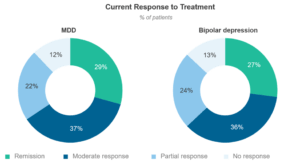
The gap becomes even clearer when looking at patient outcomes. Psychiatrists estimated that only 29% of their pharmacologically treated patients with MDD and 27% of those with bipolar depression were in remission. Approximately one-third were estimated to have only a partial response or no response at all.
Source: Spherix Global Insights, Market Dynamix™ Depressive Mood Disorders US 2026. n=102 U.S. psychiatrists.
Those findings provide important context for the attention being paid to new mechanisms. Delayed onset of action, partial response, residual symptoms, sexual side effects, metabolic issues, and payer restrictions all emerged as limitations to successful treatment in the Spherix research.
The implication is not simply that psychiatry needs more therapies. It needs treatments capable of addressing specific shortcomings that clinicians continue to encounter despite an increasingly broad therapeutic landscape.
Innovation Will Still Have to Meet the Realities of Practice
Novel approaches generated significant attention at Psych Congress, including growing interest in psychedelic therapies and other mechanisms that could expand the psychiatric treatment toolkit.
Spherix research similarly found notable psychiatrist interest in emerging options. Psilocybin therapies from Compass Pathways and Usona Institute, along with seltorexant from J&J, were among the therapies psychiatrists most wanted to see approved in depressive mood disorders.
But enthusiasm for innovation is only part of the story.
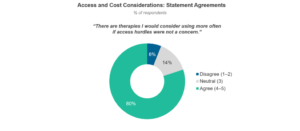
A striking 80% of surveyed psychiatrists agreed that there are therapies they would consider using more often if access hurdles were not a concern.
Source: Spherix Global Insights, Market Dynamix™ Depressive Mood Disorders US 2026. n=102 U.S. psychiatrists.
When psychiatrists considered barriers to adopting future pharmacologic treatments, payer restrictions, high out-of-pocket costs, and coverage or formulary limitations ranked prominently alongside questions involving safety, administration, and treatment guidelines.
That distinction matters. Clinical promise can create interest, but real-world adoption depends on a much broader set of considerations. Evidence requirements, patient selection, administration, affordability, coverage, monitoring, and physician comfort can all influence whether an innovation ultimately becomes part of routine care.
The Same Questions Extend Across Psychiatric Conditions
Many of the themes discussed at Psych Congress extend well beyond depressive mood disorders.
In schizophrenia, for example, controlling positive symptoms does not necessarily mean that the broader burden of disease has been addressed. In Spherix research, 68% of surveyed psychiatrists agreed that current antipsychotics effectively manage positive symptoms for most patients, compared with just 21% who said the same about negative symptoms.
Source: Market Dynamix™ Schizophrenia US 2025. n=102 U.S. psychiatrists.
That divide is important as clinicians consider newer treatment approaches. The question is increasingly not simply whether another option can control symptoms, but whether it can address areas where existing approaches continue to leave patients with significant impairment.
Similar complexity is evident when treating behavioral and psychiatric symptoms associated with Alzheimer’s disease. Here, physicians are managing agitation and psychosis within a particularly vulnerable population while weighing efficacy against tolerability, safety, caregiver observations, and access considerations. Spherix research found that physicians estimated only 41% of pharmacologically treated patients with agitation or psychosis were well managed on their current treatment.
Across these conditions, the specifics differ, but a common pattern emerges. The next treatment advance will be judged not only by whether it works, but by the particular unmet need it addresses and how readily it can be incorporated into real-world practice.
Staying Close to What Comes Next
Psych Congress reinforced that psychiatry is not changing along a single dimension. New mechanisms are advancing, expectations for treatment are evolving, and persistent gaps in outcomes, tolerability, and access continue to shape how clinicians evaluate both established and emerging therapies.
For Spherix, staying close to those conversations is an important part of understanding the market. Our ongoing research allows us to quantify what psychiatrists are experiencing in practice, while participation in meetings such as Psych Congress helps place those findings within the broader clinical discussion.
As the field continues to evolve, we will continue listening to the psychiatric community, examining where unmet need persists, and tracking how new evidence begins to influence treatment expectations and real-world practice.