
For years, the conversation in multiple myeloma has centered on extending survival, deepening response and delaying progression. Increasingly, another question is entering the discussion. What evidence would be strong enough for physicians to consider a patient functionally cured?
By: Sarah Hendry, Franchise Head, Hematology and Oncology
That question took on new urgency at the 2026 International Myeloma Society Annual Meeting, held September 23-26 in Glasgow, where measurable residual disease, treatment discontinuation, functional cure, and – most notably – a formal definition of cure itself featured prominently in scientific discussions. There, the International Myeloma Society and International Myeloma Working Group unveiled new consensus criteria defining cure as five years completely off myeloma treatment, confirmed by at least four negative measurable residual disease tests (one at the five-year mark, using next generation sequencing or flow cytometry sensitive enough to detect one myeloma cell in a million) plus clear advanced imaging at both ends of that period. New Spherix Global Insights research, fielded the weeks before the announcement, suggests that U.S. physicians are also becoming more willing to consider functional cure a credible treatment objective, but the standard of evidence remains demanding, and considerably more varied than the single bar the field’s own new consensus criteria just set.
Among surveyed hematologists/oncologists and medical oncologists, 43% identify sustained measurable residual disease (MRD) negativity as the single milestone that would most increase their confidence that a patient has achieved functional cure. Another 23% point to durable treatment-free remission, while 22% select prolonged progression-free survival and 11% choose restoration of normal life expectancy. Only 1% say they do not believe multiple myeloma can currently be functionally cured.
The implication is important. Physicians are not defining cure through response depth alone. They are looking for evidence that a deep response persists, translates into meaningful time away from treatment and ultimately supports longer-term outcomes.
MRD Negativity May Be the Starting Point Rather Than the Finish Line
The prominence of sustained MRD negativity reflects how deeply response measurement has become embedded in the evolving multiple myeloma treatment landscape. Yet the findings suggest that MRD is unlikely to stand alone as the evidence standard for functional cure.
Survival remains fundamental.
Overall survival and progression-free survival are each rated as highly important attributes of future relapsed or refractory multiple myeloma therapies by 81% of physicians. When respondents were asked to identify their three most desired attributes of future therapies, overall survival was selected by 60% and progression-free survival by 52%.
Taken together, these findings point toward a more demanding definition of clinical success. MRD negativity may provide an important early signal, but physicians appear to be looking for confirmation that depth of response becomes durability of response.
For manufacturers developing the next generation of multiple myeloma therapies, that raises the evidence bar. Demonstrating that a therapy produces deep responses will remain important, but differentiation may increasingly depend on establishing what follows those responses.
Time Away From Treatment Is Becoming Part of the Outcome
Durability also has a practical meaning for patients.
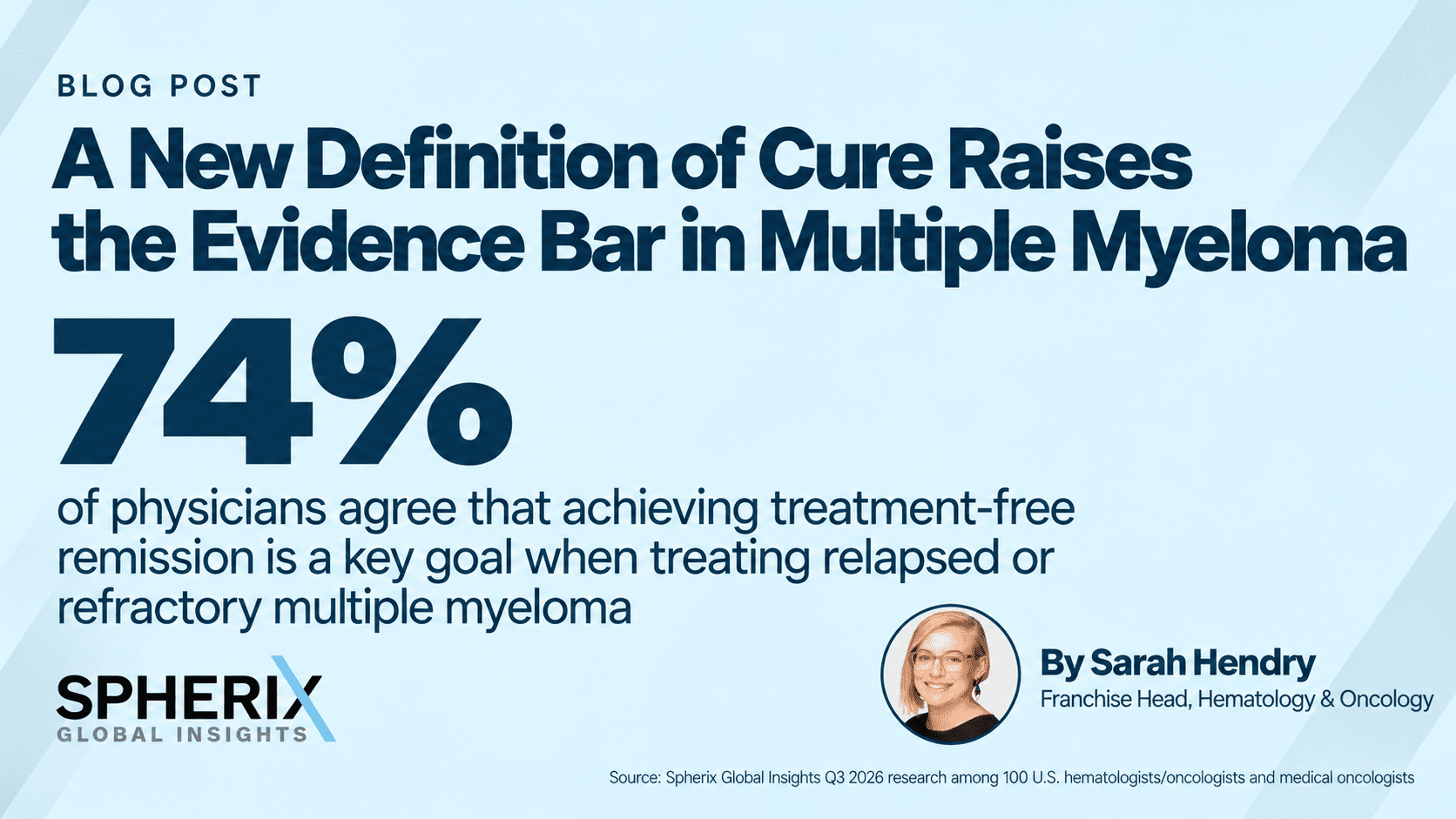
The underlying Q3 data show 74% of physicians agree that achieving treatment-free remission is a key goal in RRMM. That finding becomes even more meaningful when considered alongside the factors physicians say influence treatment recommendations when multiple clinically appropriate options are available.
Treatment frequency is the most commonly cited patient consideration, selected by 35% of respondents, followed closely by the desire to avoid hospitalization at 34% and time commitment at 31%. Route of administration, the ability to continue working or normal activities, and the desire for treatment-free intervals round out the list, each cited by roughly a quarter to three in ten physicians.
Patient Preferences Influencing Treatment Recommendations
Source: RealTime Dynamix: Multiple Myeloma 2026 Q3
These findings reinforce that the value of a durable response is not exclusively clinical. A period away from therapy can also reduce the time, logistical and quality-of-life burdens associated with continuous treatment.
As more therapies demonstrate the ability to produce deep and sustained responses, the distinction between controlling disease and giving patients meaningful time away from treatment could become increasingly important.
The Functional Cure Conversation Has Sequencing Implications
The pursuit of deeper and more durable responses also raises questions about when advanced therapies should be used.
85% of physicians believe better control of the CAR T-cell therapy timeline is crucial for improving outcomes. 74% also consider T-cell health an important factor when choosing between a bispecific antibody and CAR T-cell therapy.
At the same time, sequencing remains unsettled.
48% of physicians now agree that bispecific antibodies should be sequenced before CAR T-cell therapy in relapsed or refractory multiple myeloma whenever possible, compared with 40% in Q1 2026 and 44% in Q2. Yet when physicians evaluate specific patient profiles and assume all options are clinically appropriate, CAR T-cell therapy remains the first-ranked mechanism across most of those profiles.
That tension is significant. Broader attitudes toward sequencing are shifting, but they do not always translate directly into patient-level treatment preference.
Commercial teams therefore need to look beyond whether physicians prefer one mechanism over another. The more consequential questions involve which patients are considered appropriate at each point in the treatment journey, how T-cell fitness and treatment logistics influence those decisions, and whether delaying an advanced therapy could change the opportunity to achieve the deepest possible response.
A Higher Standard for Differentiation
The multiple myeloma market now offers physicians an expanding set of CAR T-cell therapies, bispecific antibodies, novel combinations and emerging mechanisms. More choice, however, also creates a higher threshold for meaningful differentiation.
The next phase of competition may be determined less by whether a therapy can generate a response and more by the durability and consequences of that response.
Can MRD negativity be sustained? Does it translate into longer progression-free or overall survival? Can patients experience meaningful periods without treatment? Can those outcomes be achieved early enough in the disease course and across the range of patients treated in everyday practice?
Those are increasingly connected questions.
The emerging physician definition of functional cure suggests that expectations in multiple myeloma are expanding. The goal is no longer simply deeper response, longer survival or less treatment burden considered independently. The evidence physicians appear to value most connects them.
For biopharma teams, understanding that connection will be essential as new therapies move into earlier treatment settings and established mechanisms compete for position across the relapsed or refractory treatment journey.
Source: Spherix Global Insights Q3 2026 research among 100 U.S. hematologists/oncologists and medical oncologists, fielded August 3 through August 19, 2026. The research assessed current and anticipated treatment patterns, CAR T-cell and bispecific antibody sequencing, physician definitions of functional cure, treatment goals, recent product uptake and reactions to emerging therapies across multiple myeloma.
For years, the conversation in multiple myeloma has centered on extending survival, deepening response and delaying progression. Increasingly, another question is entering the discussion. What evidence would be strong enough for physicians to consider a patient functionally cured?
That question took on new urgency at the 2026 International Myeloma Society Annual Meeting, held September 23-26 in Glasgow, where measurable residual disease, treatment discontinuation, functional cure, and – most notably – a formal definition of cure itself featured prominently in scientific discussions. There, the International Myeloma Society and International Myeloma Working Group unveiled new consensus criteria defining cure as five years completely off myeloma treatment, confirmed by at least four negative measurable residual disease tests (one at the five-year mark, using next generation sequencing or flow cytometry sensitive enough to detect one myeloma cell in a million) plus clear advanced imaging at both ends of that period. New Spherix Global Insights research, fielded the weeks before the announcement, suggests that U.S. physicians are also becoming more willing to consider functional cure a credible treatment objective, but the standard of evidence remains demanding, and considerably more varied than the single bar the field’s own new consensus criteria just set.
Among surveyed hematologists/oncologists and medical oncologists, 43% identify sustained measurable residual disease (MRD) negativity as the single milestone that would most increase their confidence that a patient has achieved functional cure. Another 23% point to durable treatment-free remission, while 22% select prolonged progression-free survival and 11% choose restoration of normal life expectancy. Only 1% say they do not believe multiple myeloma can currently be functionally cured.
The implication is important. Physicians are not defining cure through response depth alone. They are looking for evidence that a deep response persists, translates into meaningful time away from treatment and ultimately supports longer-term outcomes.
MRD Negativity May Be the Starting Point Rather Than the Finish Line
The prominence of sustained MRD negativity reflects how deeply response measurement has become embedded in the evolving multiple myeloma treatment landscape. Yet the findings suggest that MRD is unlikely to stand alone as the evidence standard for functional cure.
Survival remains fundamental.
Overall survival and progression-free survival are each rated as highly important attributes of future relapsed or refractory multiple myeloma therapies by 81% of physicians. When respondents were asked to identify their three most desired attributes of future therapies, overall survival was selected by 60% and progression-free survival by 52%.
Taken together, these findings point toward a more demanding definition of clinical success. MRD negativity may provide an important early signal, but physicians appear to be looking for confirmation that depth of response becomes durability of response.
For manufacturers developing the next generation of multiple myeloma therapies, that raises the evidence bar. Demonstrating that a therapy produces deep responses will remain important, but differentiation may increasingly depend on establishing what follows those responses.
Time Away From Treatment Is Becoming Part of the Outcome
Durability also has a practical meaning for patients.
The underlying Q3 data show 74% of physicians agree that achieving treatment-free remission is a key goal in RRMM. That finding becomes even more meaningful when considered alongside the factors physicians say influence treatment recommendations when multiple clinically appropriate options are available.
Treatment frequency is the most commonly cited patient consideration, selected by 35% of respondents, followed closely by the desire to avoid hospitalization at 34% and time commitment at 31%. Route of administration, the ability to continue working or normal activities, and the desire for treatment-free intervals round out the list, each cited by roughly a quarter to three in ten physicians.
Patient Preferences Influencing Treatment Recommendations
Source: RealTime Dynamix: Multiple Myeloma 2026 Q3
These findings reinforce that the value of a durable response is not exclusively clinical. A period away from therapy can also reduce the time, logistical and quality-of-life burdens associated with continuous treatment.
As more therapies demonstrate the ability to produce deep and sustained responses, the distinction between controlling disease and giving patients meaningful time away from treatment could become increasingly important.
The Functional Cure Conversation Has Sequencing Implications
The pursuit of deeper and more durable responses also raises questions about when advanced therapies should be used.
85% of physicians believe better control of the CAR T-cell therapy timeline is crucial for improving outcomes. 74% also consider T-cell health an important factor when choosing between a bispecific antibody and CAR T-cell therapy.
At the same time, sequencing remains unsettled.
48% of physicians now agree that bispecific antibodies should be sequenced before CAR T-cell therapy in relapsed or refractory multiple myeloma whenever possible, compared with 40% in Q1 2026 and 44% in Q2. Yet when physicians evaluate specific patient profiles and assume all options are clinically appropriate, CAR T-cell therapy remains the first-ranked mechanism across most of those profiles.
That tension is significant. Broader attitudes toward sequencing are shifting, but they do not always translate directly into patient-level treatment preference.
Commercial teams therefore need to look beyond whether physicians prefer one mechanism over another. The more consequential questions involve which patients are considered appropriate at each point in the treatment journey, how T-cell fitness and treatment logistics influence those decisions, and whether delaying an advanced therapy could change the opportunity to achieve the deepest possible response.
A Higher Standard for Differentiation
The multiple myeloma market now offers physicians an expanding set of CAR T-cell therapies, bispecific antibodies, novel combinations and emerging mechanisms. More choice, however, also creates a higher threshold for meaningful differentiation.
The next phase of competition may be determined less by whether a therapy can generate a response and more by the durability and consequences of that response.
Can MRD negativity be sustained? Does it translate into longer progression-free or overall survival? Can patients experience meaningful periods without treatment? Can those outcomes be achieved early enough in the disease course and across the range of patients treated in everyday practice?
Those are increasingly connected questions.
The emerging physician definition of functional cure suggests that expectations in multiple myeloma are expanding. The goal is no longer simply deeper response, longer survival or less treatment burden considered independently. The evidence physicians appear to value most connects them.
For biopharma teams, understanding that connection will be essential as new therapies move into earlier treatment settings and established mechanisms compete for position across the relapsed or refractory treatment journey.
Source: Spherix Global Insights Q3 2026 research among 100 U.S. hematologists/oncologists and medical oncologists, fielded August 3 through August 19, 2026. The research assessed current and anticipated treatment patterns, CAR T-cell and bispecific antibody sequencing, physician definitions of functional cure, treatment goals, recent product uptake and reactions to emerging therapies across multiple myeloma.